

1. Task overview
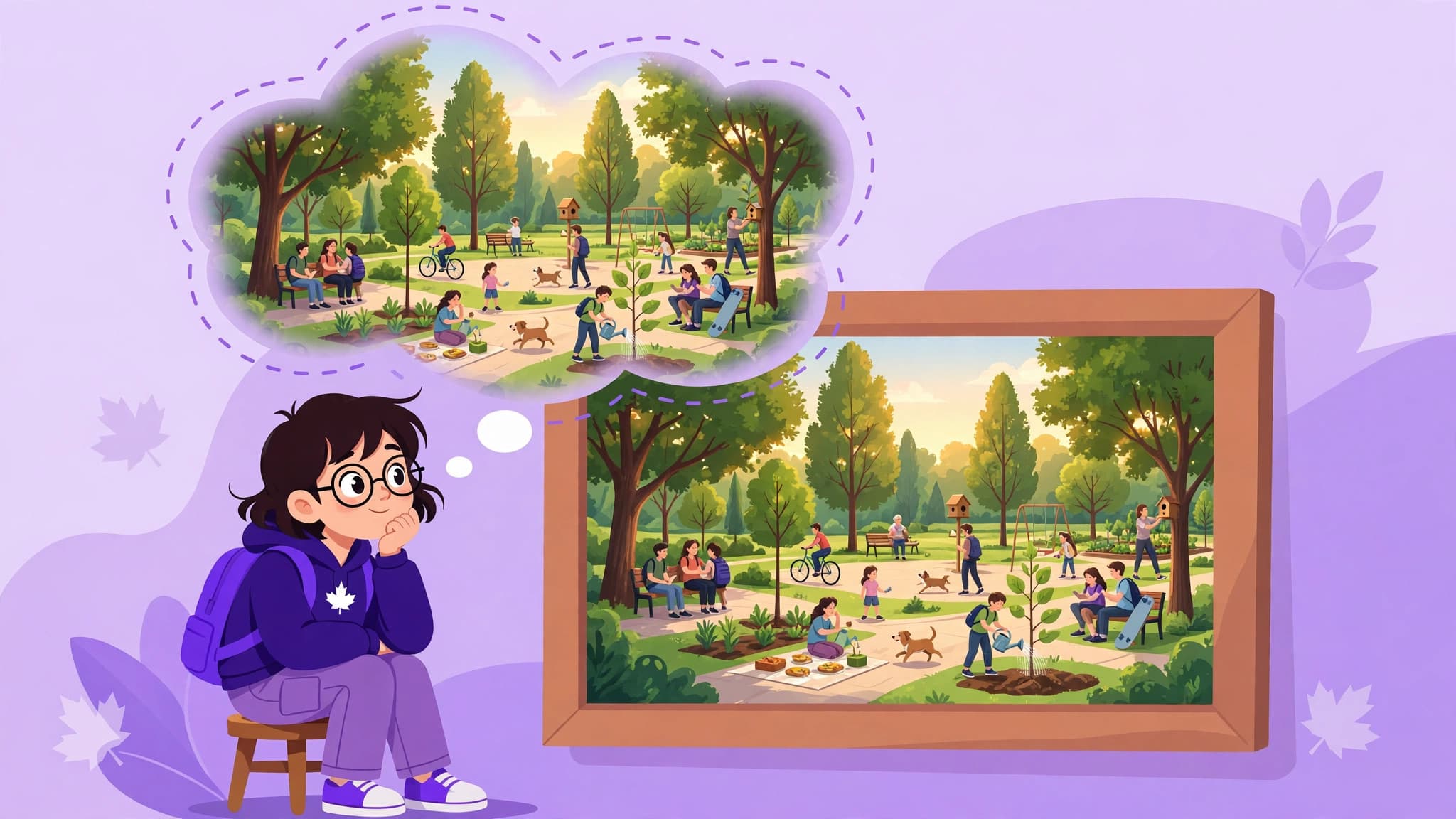
Making Predictions is the fourth task in the CELPIP Speaking test. You see the same picture that you described in Task 3. This time, you do not describe it again. You say what you think will happen next to the people in the picture.
You have 30 seconds to prepare and 60 seconds to speak into a microphone with a headset. Later, trained human raters listen to your recording and give your score.
There are no correct predictions. Any sensible guess is fine. This task tests your future language and your imagination: can you make clear guesses and explain them?
2. Facts box
| Item | Detail |
|---|---|
| Time for this part | 30 seconds to prepare, then 60 seconds to speak |
| Questions | 1 question about the picture |
| Format | The same picture as Task 3. You record your answer into a microphone |
| Answers | Spoken only. There is nothing to write and nothing to click |
| Scoring | Human raters listen to your recording later. There is no examiner in front of you |
3. Task structure
Your answer has three beats. A beat is one main part of your answer.
- • Beat 1: connect to the picture. In one short sentence, say what is happening now, so your predictions have a starting point.
- • Beat 2: prediction 1. Choose one person or one thing in the picture and say what will probably happen to them, and why.
- • Beat 3: prediction 2. Choose a second person or thing and do the same. If you have time, add a third short prediction or a general ending.
In the 30 seconds of preparation, choose two people or things from the picture and think of one guess for each. That is all you need.
4. What to expect
- • The picture is the one from Task 3. You already know the people and the actions, so your preparation time is only for making guesses.
- • Your guesses do not need to be right. Nobody knows the real future of a picture. Raters check your language, not your luck.
- • Sensible guesses work best. A guess that connects to something in the picture, for example a dark cloud or a running man, sounds stronger than a wild story.
- • When the 60 seconds end, the recording stops by itself.
5. Strategies and tips
- 1. Do not describe the picture again. You already did that in Task 3. One short sentence about the present is enough, then move to the future.
- 2. Use future and guessing words. Words like "will probably...", "is likely to...", and "might end up..." are the heart of this task. Mix them. Do not use "will" in every sentence.
- 3. Talk about at least two things. One prediction is not enough for 60 seconds. Two or three predictions mean you always have something to say, and you will not stop.
- 4. Give a reason for each guess. Connect the guess to the picture. "The man is running with a suitcase, so he will probably catch the train" is a developed idea. Developed means the idea has a reason or detail with it.
- 5. Add small next steps. After a first guess, say what happens after that. This makes one idea longer without new ideas.
- 6. Use "if" sentences for variety. For example: "If the rain starts, the people will open their umbrellas." Different kinds of sentences help your score.
- 7. Close your answer. If the time is almost finished, end with a short general sentence, for example, "So, I think everyone in this picture will have a busy afternoon." Silence is the worst mistake in Speaking.
Suggested timing split for your 60 seconds of speaking:
- • About 5 seconds: one sentence about what is happening now.
- • About 25 seconds: prediction 1, with a reason and a next step.
- • About 25 seconds: prediction 2, with a reason and a next step.
- • About 5 seconds: a short closing sentence.
6. Scoring
Raters check four things in every Speaking answer:
- • Content and Coherence. Coherence means your ideas connect in a clear order. In this task, each prediction must connect to the picture and to its reason in a way the rater can follow.
- • Vocabulary. Raters check your words. Good future and guessing language, used in a natural way, is exactly what this task asks for. You do not need big, fancy words.
- • Listenability. This means how easy it is to listen to you. Raters check your rhythm, your pronunciation, your pauses, your grammar, and your different kinds of sentences.
- • Task Fulfillment. Raters check: did you do the task fully? In this task, that means real predictions about the future of the scene, not a second description of the picture.
A lower level answer usually describes the picture again, gives only one guess, or stops early. A higher level answer gives two or three sensible predictions with reasons, uses different future forms, and fills the time well.
7. How to build an answer
How to start. Say one sentence about the present situation, then move to your first guess. For example: "In this picture, a family is having a picnic in a park, and dark clouds are coming."
How to develop. Take one person or thing at a time. Say your guess, then say why you think so, then say what may happen next. Then move to the second person or thing and do the same.
How to finish. End with one general sentence about the scene, for example: "In the end, I think they will pack their things quickly and go home before the rain." A clean ending is better than a sudden stop.
One general framework for this task:
- 1. One sentence: what is happening now.
- 2. Prediction 1, plus the reason from the picture.
- 3. What happens next, after prediction 1.
- 4. Prediction 2, plus the reason from the picture.
- 5. A short closing sentence.
A framework is a starting structure, not a script to memorize. Raters can recognize memorized templates, and templates can lower your score. Use the framework to organize your own guesses. The AI feedback on Celpip Easy looks at your own answers and gives you personal help, so you do not need a fixed script.
8. Mistakes learners make in this task
- • Describing the picture again. That was Task 3. This task is about the future, not the present.
- • Only one prediction. One guess fills about 20 seconds. Then the speaker stops or repeats. Prepare two or three guesses.
- • Guesses with no reasons. A prediction with no connection to the picture sounds weak and is hard to develop.
- • The same future form in every sentence. "Will, will, will" sounds flat. Mix "will probably", "is likely to", "might", and "if" sentences.
- • Wild guesses. Predictions that have nothing to do with the picture sound strange. Keep your guesses close to what you can see.
- • Silence. If one guess finishes early, add its next step, or start a guess about another person in the picture. Do not freeze.
9. Practice this task
Reading about the task is step one. The skill comes from doing it with real timing: 30 seconds to prepare, 60 seconds to speak, recorded once.